Your First Conversation
What talking to an MCP client actually looks like — a complete session between an AI agent and the demo server, shown twice: as the user saw it, and as your server saw it on the wire. The transcripts are from 2026-08-10; the client versions shown are the releases current on that date.
The user's view
The demo server was registered with the Codex CLI (v0.145.0) and asked one question:
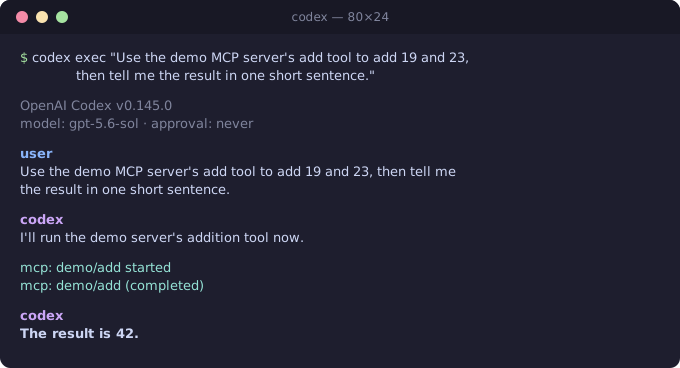
The agent decided on its own that the add tool fit the question,
called it, and used the answer. That's the whole consumer experience:
your tool became something the model reaches for.
Claude Code works the same way — register and check with:
claude mcp add demo /path/to/build/mcpdemo
claude mcp list        # → demo: … - ✔ Connected
The same session on the wire
Three requests — plus one notification — travelled over the server's stdin/stdout. Everything below your handler's one line of arithmetic was produced by the library.
1. The client introduces itself — the initialize handshake
(this client speaks protocol revision 2025-06-18; the library
serves it via its dual-era support without any configuration):
{"jsonrpc":"2.0","id":0,"method":"initialize","params":{
  "protocolVersion":"2025-06-18",
  "capabilities":{"elicitation":{"form":{},"url":{}}},
  "clientInfo":{"name":"codex-mcp-client","title":"Codex","version":"0.145.0"}}}
The server answers with its identity and the Instructions you set —
the text the model reads to learn when to use your server:
{"jsonrpc":"2.0","id":0,"result":{
  "protocolVersion":"2025-06-18",
  "capabilities":{"tools":{},"resources":{},"prompts":{}},
  "serverInfo":{"name":"pascal-mcp-sdk-demo","version":"0.1.0"},
  "instructions":"Demo server for the pascal-mcp-sdk library. Use \"echo\" to mirror a message, \"add\" to add two numbers; read mcp://pascal-mcp-sdk/greeting for a hello."}}
The client then confirms the handshake with a notification (no response expected):
{"jsonrpc":"2.0","method":"notifications/initialized"}2. Discovery — the client asks what you offer and hands the
catalog to the model. Note that your RegisterTool call became a
JSON Schema the model uses to shape its arguments:
{"jsonrpc":"2.0","id":1,"method":"tools/list","params":{"_meta":{"progressToken":0}}}{"jsonrpc":"2.0","id":1,"result":{"tools":[
{"name":"echo","description":"Echo a message back to the caller", "inputSchema":{"…":"…"}},
{"name":"add","description":"Add two numbers and return the sum",
"inputSchema":{"type":"object",
"properties":{"a":{"type":"number"},"b":{"type":"number"}},
"required":["a","b"]}, "…":"…"}]}}3. The model calls your tool. The arguments match the schema —
the library has already validated them before your handler runs
(client-specific _meta bookkeeping elided):
{"jsonrpc":"2.0","id":2,"method":"tools/call","params":{
  "name":"add","arguments":{"a":19,"b":23},"_meta":{"…":"…"}}}
4. Your handler's result goes back — human-readable content
plus the structuredContent matching the tool's output schema (the
float is serialized in FPC's exponent form; every client reads it as
plain JSON 42):
{"jsonrpc":"2.0","id":2,"result":{
  "content":[{"type":"text","text":"The sum is 42"}],
  "isError":false,
  "structuredContent":{"sum":4.2E+001}}}
Then the model told the user "The result is 42." — and when the session ended, the host closed the server's stdin and the process exited. That EOF-means-shutdown contract is why a pascal-mcp-sdk server needs no signal handling and no restart loop.
What Claude Code sends
Same choreography from Claude Code (versions 2.1.217 and 2.1.226 both open with this):
{"jsonrpc":"2.0","id":0,"method":"initialize","params":{
  "protocolVersion":"2025-11-25",
  "capabilities":{"roots":{"listChanged":true},"elicitation":{}},
  "clientInfo":{"name":"claude-code","title":"Claude Code","version":"2.1.226"}}}
Different client, different protocol revision (2025-11-25 vs
Codex's 2025-06-18) — same server, zero configuration. That is what
the dual-era default buys you: the library speaks each classic
handshake revision it supports (2024-11-05, 2025-06-18,
2025-11-25 — the revisions current clients use) and the newest
stateless 2026-07-28 revision, and picks per connection — so as
clients migrate to the stateless revision, your server needs no
change (see Configuration).
The same conversation, stateless style
Under the 2026-07-28 revision there is no handshake at all — every
request is self-contained, carrying its _meta. You can hold this
conversation yourself from a shell:
./build/mcpdemo <<'EOF'
{"jsonrpc":"2.0","id":1,"method":"tools/call","params":{"name":"add","arguments":{"a":19,"b":23},"_meta":{"io.modelcontextprotocol/protocolVersion":"2026-07-28","io.modelcontextprotocol/clientCapabilities":{}}}}
EOF
One line in, one line out — same handler, same result, no protocol session. The cookbook drives the whole surface this way.
Takeaways
- Your handler ran once, with validated typed arguments; the library produced every other byte on this page.
- Model-facing text matters: the tool
descriptionand the serverInstructionsare what made the model pickaddunprompted. - Clients disagree about protocol revisions today — the dual-era default absorbs that so you never have to ask which client your users run.